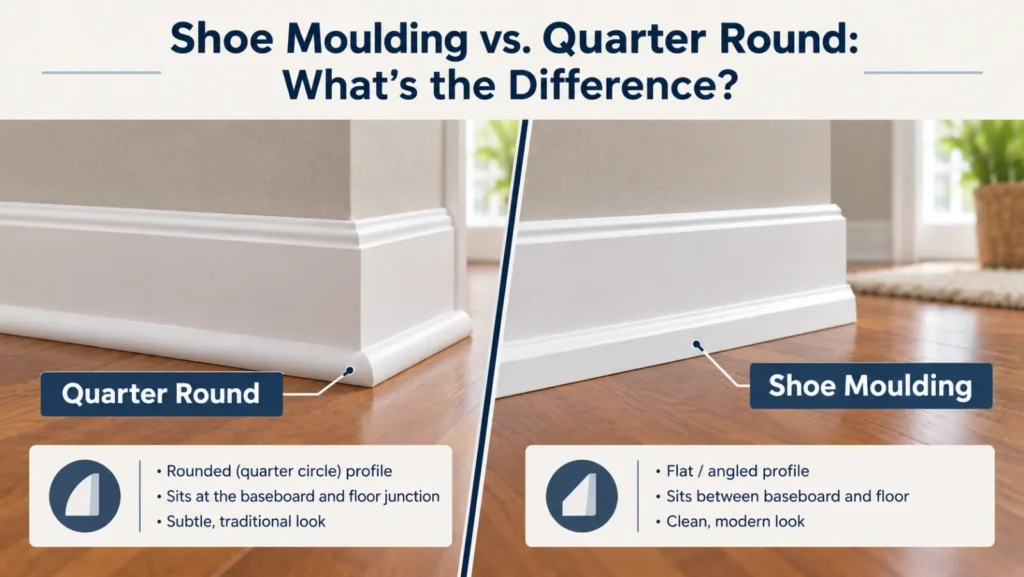

You can install new flooring and keep your existing baseboards. But there’s usually one detail left to sort out: the gap along the bottom of the wall. Do you cover it with shoe moulding or quarter round?
Both can do the job. The decision often comes down to the shape of your baseboards, how much space you need to cover and how you want the finished floor to look.
Shoe moulding has a slimmer profile, so the finish is subtle. Quarter round is fuller and rounder, and it may cover a wider gap. Neither is right for every room. And going bigger doesn’t always solve the problem.
So let’s look at the differences, where each one works best and what to check before you buy.
What Is Shoe Moulding?
Shoe moulding, sometimes called base shoe, is a narrow strip of trim that sits along the bottom of a baseboard. It covers the small gap between the baseboard and the floor, and you don’t have to replace the baseboards to use it.
Why is there a gap at all? Floors and walls aren’t perfectly level or straight. Once new flooring goes in, a little space can be left between the floor and the bottom of the baseboard. Shoe moulding hides it.
A common size is roughly 3/4 inch high and 1/2 inch deep, though the dimensions vary by manufacturer.
The narrow profile is handy when you’d like the baseboards to stay the main feature. It suits flat, simple baseboards especially well. It can look right in traditional interiors too.
Shoe moulding is worth considering if:
- The gap is small enough for a narrow trim piece to cover.
- You prefer a clean, understated finish.
- Your existing baseboards are in good condition.
- You’re installing new flooring and would rather not remove the baseboards.
- You don’t want extra visual bulk along the bottom of the wall.
One thing to keep in mind: shoe moulding can’t cover every gap. Measure first. If the gap is too wide, you’ll need a larger piece, or you’ll need to fix whatever’s causing the gap.
What Is Quarter Round Moulding?
Quarter round is shaped like a quarter of a circle. Like shoe moulding, it runs along the bottom of the baseboard and covers the gap where the wall meets the floor.
A common size is around 3/4 inch high by 3/4 inch deep. That extra depth gives it a fuller look, and in some cases it can cover a wider gap.
You’ll see quarter round a lot in homes with traditional baseboards. It isn’t limited to older interiors, though. It works with different baseboard styles as long as the proportions look right.
Quarter round may be the better fit if:
- A slimmer shoe moulding profile won’t cover the gap.
- You like a more noticeable, rounded edge.
- Your existing baseboards already have quarter round.
- You’re replacing flooring but want to keep the existing trim.
- You’re matching the finish in another room.
A bigger trim piece can hide a gap, but it won’t fix a loose baseboard, damaged flooring or a big difference in floor height. Look at those problems before any trim goes on.
Shoe Moulding vs. Quarter Round: What’s the Difference?
The easiest way to tell them apart is the cross-section. Shoe moulding is usually taller than it is deep, with a slimmer curve. Quarter round is more symmetrical and rounded.
Here’s how they stack up.
|
Feature |
Shoe moulding |
Quarter round |
|
Shape |
Slimmer, slightly curved profile |
Fuller quarter-circle shape |
|
Typical size |
About 3/4 in. high × 1/2 in. deep |
About 3/4 in. high × 3/4 in. deep |
|
Appearance |
Subtle and streamlined |
More pronounced and rounded |
|
Gap coverage |
Suits smaller gaps |
May cover wider gaps |
|
Style |
Works well with flat and decorative baseboards |
Often suits fuller, traditional baseboards |
|
Materials |
Wood, MDF or other suitable trim materials |
Wood, MDF or other suitable trim materials |
|
Installation |
Must be measured and fitted accurately |
Must be measured and fitted accurately |
Treat those measurements as common examples, not fixed standards. Check the actual product’s dimensions before you buy.
So which is better? If both cover the gap properly, either one works. Shoe moulding gives you a slimmer finish. Quarter round adds visual weight. Pick whichever fits the gap without looking out of place.
Which Looks Better With Your Baseboards?
Don’t pick based on a design trend. Start with the baseboards you already have and picture the extra trim sitting beside them.
If you have modern, flat baseboards
Shoe moulding is often a good match for flat baseboards with square edges. The narrow profile keeps the line along the floor simple, which suits contemporary rooms with clean finishes.
Quarter round isn’t off the table. Just check that its rounded shape doesn’t look bulky next to the baseboard.
If you have traditional baseboards
Quarter round can look more balanced beside taller or more decorative baseboards, especially if the same profile is already used elsewhere in the house.
Shoe moulding can work here, too. It’s all about proportion. A slim piece may look a bit lost beside a large baseboard, while a fuller piece can feel more in line with the existing trim.
If you’re matching trim in another room
Same profile all the way through is the easy answer. Say one room already has quarter round and the next one gets something clearly different. You’ll notice it at the doorway.
Doing several rooms at once? Put the baseboards, door casings, and flooring samples next to each other before you commit to a trim style.
Can You Use These Trims With Different Flooring Types?
Yes. But the flooring material changes how you pick and install the trim. You want to cover the gap, keep the floor undamaged, and let it move the way it’s meant to.
Hardwood flooring
Both work with hardwood. If the gap is fairly small, shoe moulding may cover it without adding much bulk.
How you install it depends on the type of hardwood and how it’s fitted. Fasten the trim in a way that won’t mark or damage the finished floor.
Laminate and luxury vinyl plank (LVP)
This is where installation matters most.
Lots of laminate and click-lock vinyl floors are floating floors. They need an expansion gap around the edges, because the planks shift with changes in temperature and humidity.
Either trim can cover that gap. But fasten it to the baseboard or the wall, not through the floor. Nail through a floating floor and it can’t move, and a floor that can’t move may buckle.
Read the manufacturer’s installation instructions. Then choose a profile wide enough to cover the gap they require.
Tile flooring
Either trim can suit tile. It comes down to the size of the gap, the baseboard material, and the finish you want.
Bathrooms, laundry rooms and other damp areas need a material that can handle moisture. Standard MDF can swell or break down after repeated exposure, so it’s not always the best pick there.
How Do You Choose the Right Size?
Grab a tape measure before you buy either one. The gap you need to cover matters more than the name on the packaging.
Here’s a simple way to go about it:
1. Measure along several points of the wall. The gap may change from one end to the other, especially in older homes.
2. Check the trim dimensions. The profile has to cover the widest gap without leaving an exposed edge.
3. Consider the baseboard proportions. A deep piece of quarter round can look oversized next to a narrow baseboard.
4. Check the flooring requirements. With a floating floor, the trim must cover the expansion gap without pinning the flooring down.
5. Test the fit before installation. Hold a sample against the baseboard and floor and see how it looks.
6. If the gap varies a lot along the wall, don’t assume a larger piece will fix it. The baseboard or flooring may need adjusting first.
Is Shoe Moulding or Quarter Round More Expensive?
Neither one is always cheaper. Price comes down to the material, profile, finish, and how much trim you need.
Basic wood or MDF profiles are often affordable. Solid wood, specialty materials, and prefinished products cost more. Honestly, the gap between two specific products can matter more than whether one is labelled shoe moulding and the other quarter round.
Installation costs depend on the room, too. Long, straight walls are easier to finish than a room with lots of corners, built-ins and uneven surfaces.
When you compare quotes, look past the price per linear foot. Ask whether it covers measuring, cutting, fitting, fastening, filling nail holes, caulking, and painting or staining.
And if you’re replacing the baseboards as well, compare that option with adding a separate trim piece. Depending on the room and the flooring installation, a different baseboard size may cover the gap with no extra moulding at all.
Common Mistakes to Avoid
A small piece of trim can make a whole flooring job look unfinished if it’s poorly chosen or installed. Watch out for these:
- Choosing trim that’s too small: The gap is still visible, so the extra trim hasn’t solved anything.
- Using a profile that’s too bulky: The trim can look out of proportion with the baseboard.
- Nailing into a floating floor: This can stop the flooring from moving the way it’s meant to.
- Ignoring uneven surfaces: Big gaps may need correcting before the trim goes in.
- Leaving rough corner joints: Badly fitted inside and outside corners stand out on an otherwise neat wall.
- Skipping the finishing work: Unfilled nail holes, rough edges and patchy caulking can spoil the final look.
Measure, dry-fit the pieces and prep the surfaces. It makes a real difference.
Shoe Moulding vs. Quarter Round: Which Should You Choose?
Still undecided? Focus on the gap, the baseboards and the flooring.
Go with shoe moulding when its slimmer profile covers the gap and gives you the finish you want. Consider quarter round when you need a fuller profile or want to match the existing trim.
Installing laminate or floating vinyl? Make sure the trim lets the floor move the way the manufacturer requires.
And don’t forget the option of no extra trim at all. If the baseboards can come off and go back on over the new flooring, they may cover the required expansion gap by themselves. That depends on the flooring system and the installation details, but it’s worth raising before work begins.
For homeowners planning a flooring or interior trim update, LDS Reno provides trim carpentry services across Toronto and the GTA, including baseboard and shoe moulding installation.
If you’re unsure which profile will suit your baseboards or cover the gap properly, request a free estimate from LDS Reno to discuss your project.
Frequently Asked Questions
Is shoe moulding the same as quarter round?
No. Both cover the gap between the baseboard and floor, but the profiles are different. Shoe moulding is generally slimmer. Quarter round has a fuller, quarter-circle shape.
Can I use quarter round instead of shoe moulding?
Yes, as long as it covers the gap and works with your baseboards and flooring. Quarter round may give you more coverage, but it can look bulkier than shoe moulding.
Do modern homes use quarter round trim?
Yes. Quarter round can work in modern homes, though its rounded profile is more noticeable than shoe moulding. The best choice depends on the baseboard design and the look you want.
Should quarter round match the baseboard or the floor?
Matching the baseboard is a common choice because the trim then looks like part of the wall’s lower edge. Matching the floor can work too, particularly with factory-finished flooring that has coordinating trim. Look at the surrounding finishes before you choose a paint colour or stain.
Do I need quarter round with new baseboards?
Not necessarily. If the baseboards cover the required gap and are installed correctly, you may not need an additional trim piece. It depends on the baseboard dimensions and the flooring requirements.
Can shoe moulding cover uneven floors?
It can hide minor variations, depending on the profile and material. Larger gaps or big changes in floor height may need fixing before the trim goes in.
Is quarter round necessary for laminate flooring?
No. Many floating laminate floors need an expansion gap, but suitable shoe moulding or quarter round can cover it. Install the trim so it doesn’t restrict the flooring’s movement, and always follow the manufacturer’s instructions.